
Berger Blog
With artificial intelligence against flooding
The disaster in July 2021 also caused a lot of damage to Andreas Groß's company.
With artificial intelligence against flooding
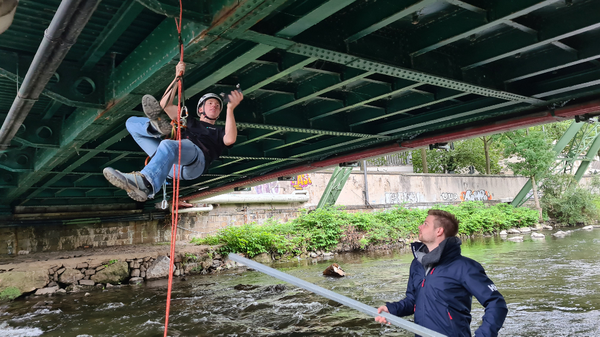
The catastrophe in July 2021 also caused a lot of damage to Andreas Groß's company. The man from Wuppertal has now developed a flood early warning system that is supposed to learn itself. It is already in use on the Wupper River.
WZ, January 4th 2022
by Jörg Isringhausen
Wuppertal | When Andreas Groß finds himself knee-deep in water from his company in the Kohlfurth district of Wuppertal on the night of July 14 to 15, he makes a decision: to do everything humanly possible to ensure that such a catastrophe cannot happen again. Around 90 percent of the Heinz Berger machine factory had been flooded by the Wupper at that time, about 7500 of 8000 square meters of factory space. Desperate, Managing Director Groß and employees tried to push heavy machinery in front of the gates to push back the flood. "I thought we were going to lose the company," he said. "That was the most difficult day in my life." But it was also the birth of his flood early warning system.
The fact that he was able to consider developing such a procedure at all is, in Groß's view, due to a constellation that is "favorable" in retrospect. On the one hand, the Heinz Berger company had one of the highest loss totals in the Bergisch region; the motivation to protect against a renewed crisis was therefore high. For another, it is a company that deals with machinery, specifically networked sensor technology and artificial intelligence (AI). Groß himself has a PhD in AI and pattern recognition, and his company makes so-called intelligent agents, machines that are networked with each other. "Technically, the topic of a networked warning system was therefore not new," says Groß.
Until then, there had been a total of four sensors in the course of the Wupper, two of which failed during the extreme flood. Of course, this meant that information about rising water levels was no longer possible, explains Groß, who then developed his own early warning system. His sensors, which are installed under bridges, measure the water level ultrasonically by registering the changing distance to the water surface from their position. The sensors are attached with a strong magnet and equipped with a GPS positioning system and temperature sensors, among other things. Groß has already installed a total of 19 sensors along the Wupper and its tributaries in the Wuppertal-Remscheid-Solingen triangle, and plans to install up to 50 along the 116 kilometers of the river. The sensors of the Wupperverband are also integrated. "This is the most closely meshed level control system in the whole of Wuppertal," says the managing director.
However, the sensors alone are not sufficient for a reasonable forecast. Therefore, data on current precipitation levels from the entire region are added to calculate the development of water volumes in the rivers. Both the data on water levels and rainfall amounts are transmitted to a computer via a so-called Long Range Wide Area Network, a standard for data transmission used in many cities. This can otherwise be used in urban areas to monitor traffic, control street lighting or determine whether trash containers are full, among other things. "This system is intended to be adaptive, i.e. self-learning, and to calculate a hazard potential from the information," says Groß. The main aim is to give the affected regions a time advantage that will allow them to still implement precautions against the expected flooding. This stage is being worked on, he adds.
Groß would like to make the early warning system accessible to all citizens via an app. "It has to be public and free of charge," he says, adding that it should be applicable to many different situations. For example, individual warning levels would have to be defined for residents and local water levels would have to be available online. Water levels could also be optimized in dry phases, for example during low water.
Groß, who is also the vice president of the Bergisch Chamber of Industry and Commerce, hopes that his project will become a model project that attracts widespread interest in other flood regions. So far, he has invested around 80,000 euros in his system; no subsidies have yet been received. However, the Wuppertal public utility company is already on board, and the mayors of the three Bergisch cities and the Bergisch University are supporting his project. In the near future, Andreas Groß also plans to approach the Ministry of Economics of the State of North Rhine-Westphalia in order to secure financial backing for his project. "We simply want to show what is technically possible in flood prevention," says the AI expert. "After all, this is a topic that comes up again and again and affects many people."