


CNC grinding machines with robot-controlled feed systems in digital production
Grinding + polishing, March 2020
Deburring, grinding, gear cutting and polishing are core competencies of the Berger Gruppe. The German group of companies presents solutions for machining workpieces of different geometries and sizes using robot technology and intelligent feed systems.
In the production of more and more workpieces, the most precise workpiece tolerances must be adhered to in order to guarantee the quality of the end product. Measuring systems in conjunction with robot technology are playing an increasingly important role in grinding processes.
The Berger Gruppe presents various CNC-controlled grinding machines that process machine and/or circular knives in different grinding processes. Surface grinding, blasting grinding and serrated grinding are achieved on the workpiece.
Various series of CNC grinding machines are designed for grinding, deburring, polishing and/or serrating individual workpieces or steel strips. Integrated camera or laser measuring systems enable the most precise tolerances to be maintained.
Grinding of machine knives
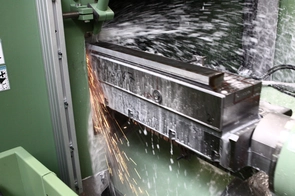
Surface grinding is a widely used grinding process. It is mainly used for processing flat and plane workpieces. Flat grinding can be achieved using both deep grinding and pendulum grinding.
Face grinding machines process workpieces with face-side cross grinding or face-side deep grinding. With a cutting speed of up to 50 m/s, multi-sided smooth grinding is achieved on machine knives. Depending on the diameter of the cup grinding wheel used, workpieces with a grinding length of up to 1,200 mm can be processed.
For the production of machine knives, CNC-controlled grinding machines are equipped with two feed axes and up to four contouring axes. Thanks to a combination of a stone axis to compensate for stone wear and an additional feed axis for grinding the workpiece, a high degree of rigidity is achieved. With an additional vertical axis and a rotation axis, bevel grinding on the contour of the workpiece is achieved in addition to flat grinding of the side surfaces.
If the workpiece is machined using the deep grinding process, a large amount of material can be removed and a good surface quality can be achieved.
Peripheral grinding wheels are used to achieve serrated grinding, scalloped grinding and/or serration on machine knives.
Specially designed peripheral grinding machines machine long knives with a maximum length of 1,800 mm using up to six CNC axes. The peripheral grinding wheel is moved using four CNC axes and the angle of the magnetic clamping table is adjusted using two further CNC axes. The grinding machine cuts machine knives at a cutting speed of up to 65 m/s using orthogonal deep grinding or plunge-cut grinding.
Knives with straight or serrated cutting edges are ground at a programmable angle. The tooth shapes are programmed via a user-friendly menu. This makes it possible to quickly grind almost any tooth profile, especially pointed or serrated teeth, even for small quantities or prototypes. With the help of an additional CNC rotation axis, circular knives can be serrated with and without relief grinding.
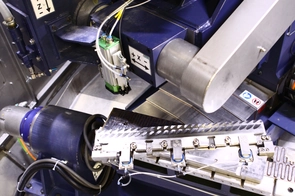
Workpiece feeding as well as loading and unloading of the processing machine can be automated. The sanding machine is combined with a robot-controlled feed system. The workpiece is either removed from a magazine by robots or fed as bulk material on a conveyor belt.
Workpieces provided as bulk material are separated using vibrators. A 2D camera recognition system records the orientation and position of the individual part so that it can be picked up by the robot in the correct position. The workpiece is then positioned in the grinding machine by the robot and deposited in another magazine after processing.
Sensors in grinding technology
A central control system connected to the grinding machine interacts with an automated feed system as well as with the workpiece and tool magazines. A bus-based recording of sensor signals is integrated into the grinding machine. Signals such as coolant temperatures, motor load, AE signals for spindle monitoring or air pressure are recorded and processed via intelligent sensors and actuators so that decisions can be made and implemented for resource control. This process data is recorded via a specially developed interface in order to optimize production processes and identify process dependencies. In this way, downtimes and set-up times are optimized and capacity planning is improved.