


Heinz Berger Maschinenfabrik GmbH & Co KG
Grinding and polishing machines for more than 70 years
Since 1957 BERGER has been manufacturing grinding and polishing machines specially designed for processing cutlery and hand tools, but also for use in other areas of metalworking.

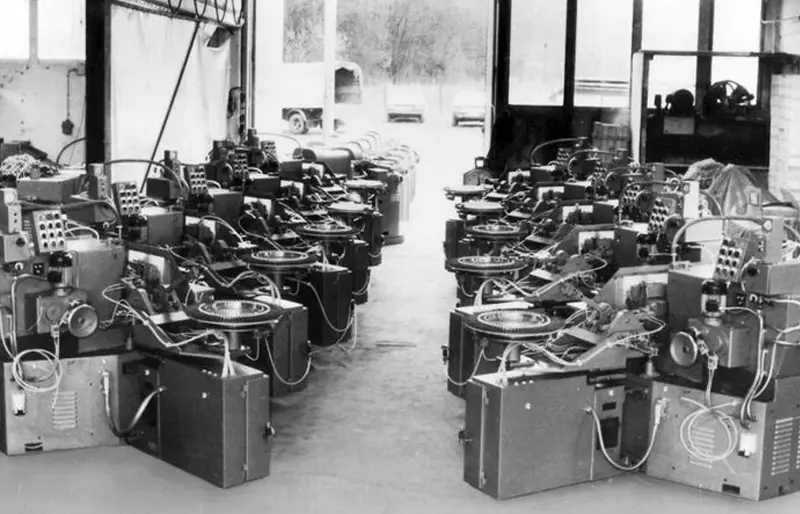
Company Berger 1960
Since 1957 BERGER has been manufacturing grinding and polishing machines specially designed for processing cutlery and hand tools, but also for use in other areas of metalworking.
FIRMA JULIUS BERGER | The idea of manufacturing machines for cutting tools was born early on. In 1928, Heinz Berger joined the company Julius Berger, founded by his father, as an engineer. The company had started with the production of garden cutting tools, which it still manufactures today.
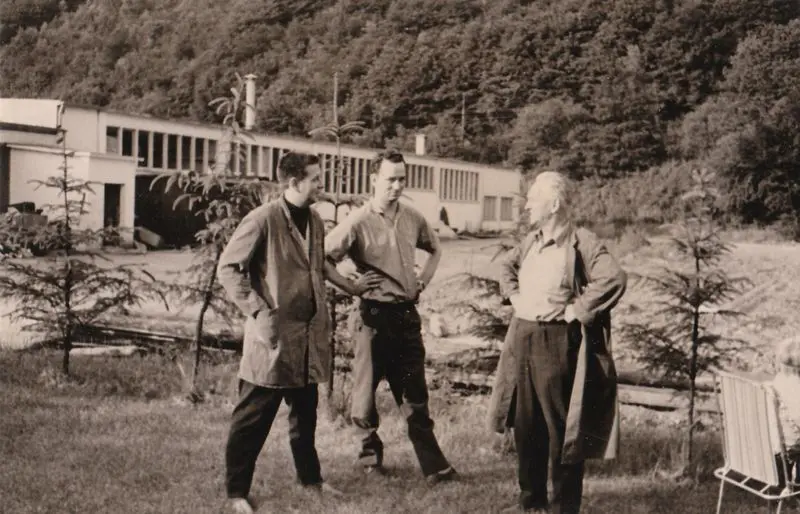
Karlheinz Berger (m.) and Heinz Berger (r.) 1965
Grinding was – and still is – an important process in the manufacture of cutting tools. At the time, manual processing required a great deal of skill and physical effort. The need to simplify and improve this labor-intensive process led to the development of grinding machines. These machines were successfully used in the company for the production of cutlery.
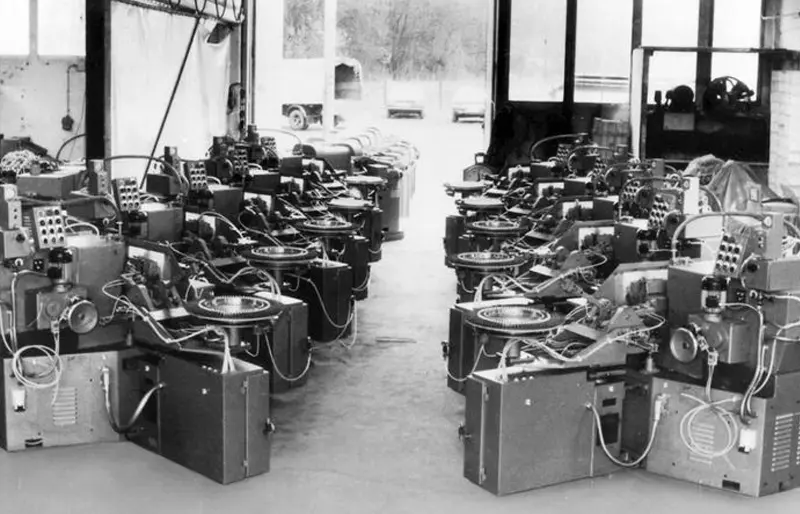
Grinding machines 1975
THE POST-WAR PERIOD | The entire business was dormant during the Second World War until 1946, after which, in addition to the production of garden tools, the development and construction of grinding machines was also driven forward, based on the experience gained up to that point in in-house production.
Initially, machines were supplied to the neighboring cutlery and tool manufacturers in Solingen, Cronenberg and Remscheid. Exports to France and Italy followed in 1951.
FOUNDING HEINZ BERGER | The mechanical engineering department, which developed well in the following years, was separated from Julius Berger in 1957 and continued by Heinz Berger as the independent company Heinz Berger Maschinenfabrik.
The rapidly increasing demand soon required larger capacities. In 1959, the machine factory was relocated from its headquarters in Berghausen to the new premises on the Kohlfurther Bridge. The conditions were now in place to expand the model range through intensive new developments and to sell it worldwide. Up to 75% of production was exported.
KARLHEINZ BERGER | After the death of Heinz Berger in 1970, his son Karlheinz Berger took over the management of the company.
In the following years, new machine concepts with mechanical and hydraulic drive technology were developed. The proportion of machines with automatic workpiece feed became ever greater.
ENTRY CHIESURA / GROSS | Since the early 1990s, the third generation has been involved in the company with daughters Claudia and Heike and sons-in-law Dr.-Ing. Andreas Groß and Marco Chiesura.
The new development of machines based on CNC drive technology has resulted in a range of more than 40 models with up to six servo axes.
The integration of innovative technologies such as robot automation and modern measurement technology is being consistently driven forward. Depending on the requirements, four to seven-axis robots are used. Initially used for the automatic workpiece feed of the grinding and polishing machines, robots are now also used for grinding and polishing workpieces. Since the opening of the technical center for robot applications, further processes have been developed.
OUTLOOK | With a core of highly qualified employees, ever more advanced solutions have been and are being found in a constant, consistent process of new and further development, whereby the realization of user-specific machining tasks is a particular strength.
Over the decades, Heinz Berger Maschinenfabrik has become a competent partner to manufacturers of cutlery, hand tools, machine knives, surgical instruments and circular knives worldwide.