


Grinding + polishing, 1/2023
Deburring, grinding, sharpening, gear cutting and polishing are core competencies of the Berger Gruppe. At GrindTec 2023 in Leipzig, the Wuppertal-based group of companies will be presenting solutions for processing machine knives with robot technology and intelligent feed systems.
In the manufacture of machine knives, the most precise workpiece tolerances must be adhered to in order to guarantee the quality of the end product. Measuring systems in conjunction with robot technology are playing an increasingly important role in grinding processes.
At GrindTec in Leipzig, the Berger Gruppe will be presenting various CNC-controlled grinding machines that process machine and/or circular knives in different grinding processes. Surface grinding, blasting and serrated grinding can be achieved on the workpiece.
CNC grinding machines grind, deburr, polish and serrate both individual workpieces and steel strips. Integrated camera or laser measuring systems enable the most precise tolerances to be maintained.
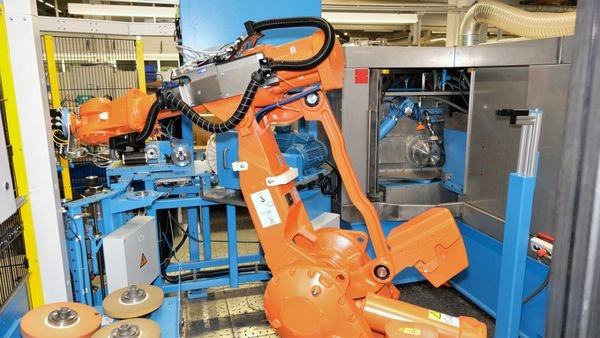
Workpiece feeding as well as loading and unloading of the processing machine can be automated. The sanding machine is often combined with a robot-controlled feed system. The workpiece is either removed from a magazine by robots or fed as bulk material on a conveyor belt.
Workpieces provided as bulk material are separated using vibrators. A 2D camera recognition system records the orientation and position of the individual part so that it can be picked up by the robot in the correct position. The workpiece is then positioned in the grinding machine by the robot and deposited in another magazine after processing.
New at the GrindTec 2023
The new generation of the RFS/RT/NT peripheral grinding machine will be presented for the first time at GrindTec 2023.
The grinding machine achieves surface and/or bevel grinding on circular knives, saw blades and circular blanks using the pendulum or plunge-cut method. Thanks to an additional grinding axis, subsequent grindings can be carried out in one clamping. For example, the surface of the workpiece can be ground flat and a bevel machined onto the cutting edge in a single work cycle. The circular blade is held in the rotating workpiece holder by mechanical clamping devices, permanent magnets or electromagnets.
The workpiece holder is mounted on a rotary table that can be continuously adjusted at an angle of -10° to 60° so that a wider range of wads can be processed on the circular blade.
After each dressing cycle, the traverse paths are automatically compensated and adjusted to the preset peripheral speed.
The workpiece and grinding wheel are changed fully automatically using a handling robot. The robot can be equipped with a specially designed dual gripper so that it can pick up both the circular knife and the grinding wheel.
Thanks to robot automation, the set-up and changeover time is reduced from 30 minutes with manual loading and unloading to 3 minutes.
The processing machine can be equipped with sensors and thus becomes a data supplier. This includes operating states as well as status and process information. Measured values are recorded by intelligent sensors and transmitted to the machine controller via IO-Link. This communicates with a decentralized higher-level control system. Here, decisions can be made to optimize productivity and the use of resources as well as an evaluation of the process.