


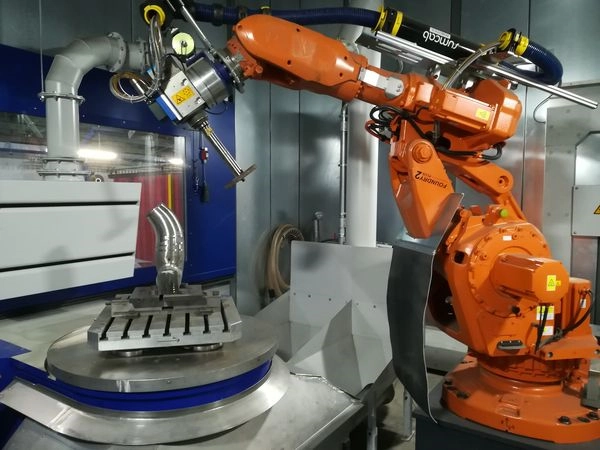
Robot-controlled surface processing of geometrically complex castings with 3D contour detection and intelligent force-torque sensor technology
The newly developed, highly universal robot cell is designed for fettling and machining the surfaces of workpieces weighing up to 100 kg with complex geometries. The aim of the machining process is to evenly remove at least 1 mm of material thickness from the entire surface of the workpiece to be machined (examples: Pipe fittings from the petrochemical industry or engine parts from the automotive industry).
The workpiece to be processed is fixed on a rotary table with a pallet clamping system and thus brought into the processing position. Two pallets are arranged in a 180° position on the rotary table. While the first workpiece is being processed in the robot cell, the next workpiece can be clamped into the second pallet clamping system on the rotary table. The rotary table rotates the workpiece to be processed into the robot cell and positions the pallet in the correct position with a zero-point clamping system on a second CNC rotary table within the robot cell. This rotary table with the clamped pallet and the workpiece on it is controlled by the 6-axis industrial robot as a freely programmable seventh axis, thus enabling optimum processing and intervention positions.
The machining robot is equipped with a compact, water-cooled high-performance spindle, which ensures optimum workpiece accessibility in conjunction with the additional CNC rotary table. A force-torque sensor integrated into the robot gripper precisely controls the pressure of the tool on the workpiece, so that force-sensitive machining operations can also be carried out on the workpiece. This enables fully automated all-round machining of complex geometries.
Due to the material properties of the high-alloy steels of the workpieces, wear-resistant tools – in this example, grinding wheels – are used for machining. However, the system can also work universally with other tools, e.g. milling tools. For this reason, the grinding/milling spindle is equipped with a tool changing system with up to 132 tools, which replaces worn tools with sister tools and ensures a continuous production process over many hours. Machining a workpiece requires three tool changes in this application.
Force-torque sensor technology has been used for several years in the field of robotics for the seamless machining of either undefined or variable workpiece contours and force-constant pressure control in machining processes. The innovative content of the process presented here lies in the combination of force-torque sensor technology with the machining of complex 3D-defined surfaces and a constant force control orthogonal to the surface with simultaneous tool wear compensation. The 3D design drawings of the workpieces are read in via CAM software and the necessary robot paths are programmed offline, whereby the tool paths are calculated in six or multi-axis codes.
The challenge of this innovation lay in the use of abrasive tools, as not only the workpiece circumference but also the diameter of the grinding wheel changes during machining. By intelligently programming and linking the CAM software with the force-torque sensor system, we succeeded in doing what even the software manufacturer thought was impossible. With the help of this networking and in combination with a 3D grinding wheel measuring system, the robot processes complex surfaces with high material removal using different abrasive tools in a force-sensitive manner. When a predefined grinding wheel diameter is reached, the tool is automatically replaced via a tool changing system integrated into the gripper.
The combination of force control and CAM programming of the workpiece geometry and the associated robot paths is particularly necessary for cast parts with large dimensions and the resulting deviations. The deviations of the real workpieces from the drawing can amount to several millimeters. The workpiece is therefore additionally measured at specified reference points before processing using a laser distance sensor attached to the robot arm. The measuring points determined in this way are included in the calculation of the paths as correction values for the workpiece geometry. The actual path control is then force-controlled.