


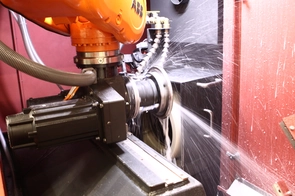
Grinding the cutting edge of circular knives
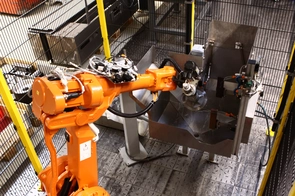
(Re)sharpening circular knives
Different grinding processes for processing round and circular knives to exact tolerances
Grinding + polishing, June 2020
Different grinding processes are used to produce circular knives, saw blades, cutter knives, circular blanks and similarly shaped workpieces, depending on the type of machining to be carried out on the workpiece.
A central production step in the manufacture of circular knives is the machining of the cutting edge. Specially designed grinding machines and robot cells grind the cutting edges, serrate the workpiece and/or deburr circular knives. Both new and used workpieces can be processed here.
Surface and bevel grinding on circular knives
With high concentricity and surface grinding accuracy, peripheral grinding machines from the RFS-CNC series with up to six CNC axes achieve peripheral grinding on surfaces, cutting edges and contours of circular knives, saw blades, circular blanks and master blades. Surface or bevel grinding is achieved on workpieces with a maximum diameter of 1,200 mm using the pendulum or plunge-cut method.
By using an additional grinding axis, it is possible to process subsequent grindings in one clamping. In conjunction with a tactile measuring system with additional damping of the probe, interrupted grinding can also be achieved with high precision.
The sanding machine is often combined with a robot-controlled feed system. The workpiece is positioned in the sanding machine by a handling robot and deposited in another magazine after processing. The travel paths are automatically compensated after each dressing cycle and adjusted to the preset peripheral speed via a frequency converter integrated into the control system.
Programmable cutting edge grinding
Rotary table grinding machines from the RMS-CNC series achieve programmable cutting edge grinding on circular knives. The four-axis grinding machines are equipped with a cup wheel so that work can be carried out with high metal cutting.
The outer diameter of the circular blade is measured using a laser. One or two cutting edges are then ground on the workpiece. Existing serrations can be ground out and any chipping in the cutting edges of used knives can be evaluated. Dressing is carried out using either a programmable dresser or a dressing roller.
Serrated grinding on circular knives and saw blades
Using a peripheral wheel, serration can be ground on circular and cutter knives as well as saw blades. The peripheral grinding machines in the RVZ-CNC series are designed for serrating circular knives with a maximum diameter of 850 mm. The machine and tooth profile are programmed via a four-axis CNC control. The workpiece is measured before machining. Dressing can be generated with a programmable dresser or a dressing roller.
If a peripheral grinding machine from the WS4-CNC series is integrated into a robot cell, serrated grinding can be achieved on circular knives. The workpiece is picked up by a processing robot. After measuring the outer diameter at a tactile measuring station, the circular blade is fed to the peripheral grinding machine for gear cutting.
Deburring and (re)sharpening of circular knives with robot technology
In a specially configured robot cell, both the serration of a circular knife and circular knives with a smoothly ground cutting edge can be deburred. The workpiece is gripped by the processing robot, ground in a processing station with a diamond grinding wheel and deposited in a stacking magazine.
Before machining, the outer diameter of the circular blade is measured at a laser measuring station and the sequence program is corrected accordingly.